Why I chose these two rotational movements for the free audio lessons
How small movements can have big effects
Many people notice that Feldenkrais lessons have a broad effect: moving more lightly, better balance, smoother coordination, more spacious breathing, a calmer mind, and a more pleasant mood.
But where does that actually come from?
And why these two rotational movements specifically for the free audio lessons?
In this blog, I’ll take you along in the thinking behind that choice.
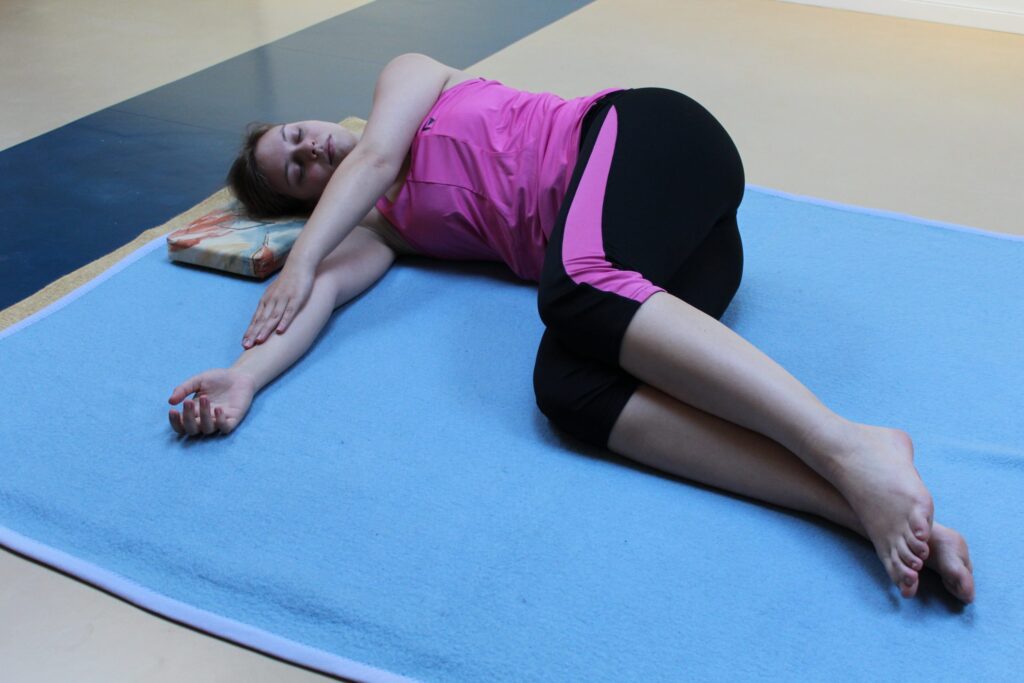
Why we often move without feeling
In our culture, we usually move without really noticing what we’re doing.
We only feel it when something starts to hurt, when certain parts of our body have already been “not participating” for a while, staying stiff or working against us.
Many complaints arise because we don’t notice that a movement stops somewhere, or that we’re blocking parts of ourselves. And when we don’t feel that, we just keep going in the same way — sometimes for years.
A Feldenkrais lesson restores that sensitivity: you don’t move better by trying harder, but because your body relearns to feel what is possible.
Feeling movement and the power of a clear structure
Every Feldenkrais lesson consists of small steps, a logical progression.
Body parts that used to work past each other suddenly begin to cooperate.
Parts that were held tight for years start to participate again.
That’s the power of sensing movement: first observing, then varying, then discovering that there is more space than you thought.
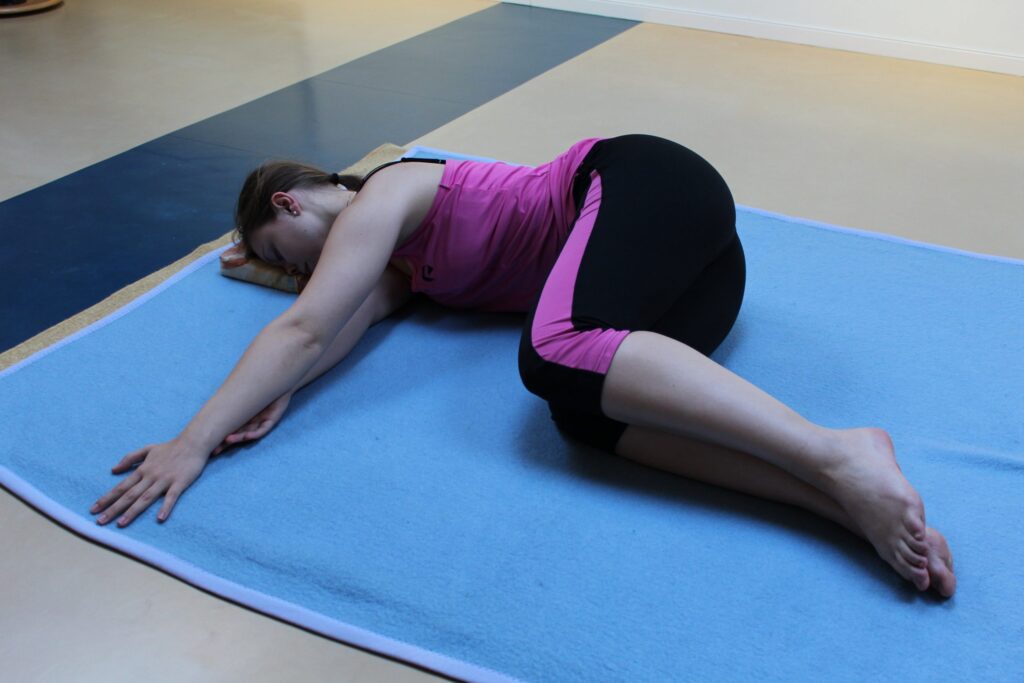
The torso as an element of movement
The torso plays a central role in almost everything you do.
Yet many people unconsciously hold their torso — rib cage, spine, diaphragm — tight. Sometimes out of habit, sometimes because of emotion, sometimes simply because they don’t know any other way.
When the torso is allowed to move along, everything changes:
- breathing becomes freer
- movement becomes lighter
- balance becomes more stable
- emotions can flow more smoothly
And you can’t make rotational movements without involving the torso. That’s why rotations are so important. They invite exactly that part of the body that is often held the most.
Why rotational movements make such a big difference
he spine can rotate the most in the area of the thoracic vertebrae, not in the waist.
Yet many people (often unconsciously) try to rotate mainly there, which overloads the lumbar spine. This can cause back complaints, sometimes even herniated discs.
When the thoracic spine does participate:
- the ribs gain more freedom of movement
- the rib cage has more space
- pressure on the lower back decreases
- and movement in general becomes easier
A free rib cage is often a key factor for neck, shoulder, hip, and knee complaints as well.
That’s why I chose two rotational movements as free audio lessons:
one lying on your side and one sitting.
They open exactly the area that is most restricted for many people with complaints.
Moving lying down: working with as little “posture” as possible
When you’re lying down, you don’t have to do any work to hold yourself upright.
The floor supports you, allowing the muscles that are normally busy with being upright to relax and become part of the movement.
That’s why the body can start cooperating much faster when lying down.
Sitting is more challenging, but precisely for that reason important — because we spend a large part of our lives sitting.
How to get the most out of these two lessons
If you want to work only with these two audio lessons, it works well to:
- start with the lying rotational movement
- do it daily for a while
- sometimes with the audio, sometimes without
- sometimes the whole lesson, sometimes just a part of it
- then occasionally add the sitting lesson
- and alternate based on need and attention
Stop when you notice you’re no longer really feeling; start again when curiosity returns. Often you suddenly hear or notice new things.
Every lesson opens a new perspective
Moshe Feldenkrais didn’t develop more than a thousand lessons for nothing.
Each lesson has a different entry point, a different perspective, a different way of waking up your system. Sometimes it feels obvious, sometimes confusing, but it always works on multiple levels at the same time.
It accumulates: each lesson builds on what the previous one has opened.
Feldenkrais is therefore not only for people with complaints, but for anyone who wants to move with more pleasure and live their full potential.
Curious?
Take a look around my website — there’s always something that invites you to discover more.