Five myths about posture – part 1
Why being upright can be lighter than you think
Many people see posture as something that requires effort: tightening muscles, straight back, shoulders back, paying attention. But a natural posture doesn’t arise from hard work. It’s a way of being upright that is stored within us, shaped by thousands of generations of evolution and by the way we learned to sit, stand, and walk as babies. Our body actually knows exactly how to do this.
Still, many people develop complaints when they stay in the same posture for a long time. Back pain, fatigue, stiff shoulders — these are often signals of what we call static complaints. We simply sit much more than is good for us, and we use our thinking to “help” ourselves sit or stand upright. But it’s precisely that thinking that can disrupt our natural way of moving.
We try to control our motor system as if it were a simple mechanism. But movement isn’t a calculation; it’s a complex interplay of muscles, bones, balance, and sensation. When we try to manage this from ideas — how we think we shouldsit or stand — we often lose contact with our natural organization.
That’s why there are quite a few myths about posture. Myths that make us work harder than necessary and feel less support than our body actually provides.
In this blog, I’ll discuss the first one.
Myth 1: “I have to hold myself upright against gravity.”
Many people believe that being upright is a struggle against gravity — that you have to lift yourself, tense yourself, carry yourself. And if you believe that, you’ll indeed use far more muscles than necessary. But the beautiful thing is: it really doesn’t have to be that way.
Gravity is actually there for us, not against us. It works in two ways at the same time.
One force pulls you downward, toward the earth. The other force — the reaction of the ground — pushes you upward. The surface beneath your feet supports you and returns the force needed to bring you upright. Our skeleton is designed to guide these forces effortlessly. Your muscles don’t have to take over that job.
When muscles allow the skeleton to do its work, a very different experience of being upright emerges: less effort, more support. As if you’re resting within yourself, while your muscles are free for the movements you want to make.
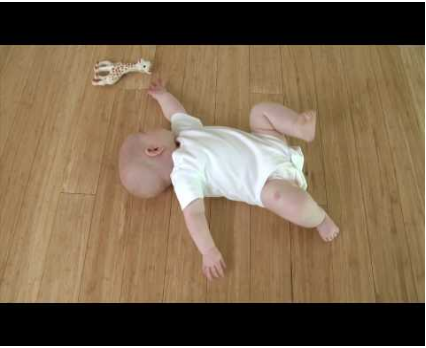
We once learned this perfectly. Just look at a baby who wants to roll over: the whole body participates. Weight subtly shifts in the direction of the movement, an arm or leg gives a small impulse, and the rest follows naturally. At first it’s a bit jerky; later it becomes smooth and flowing. Muscles and gravity begin to cooperate instead of working against each other.
You can see this beautifully in this video of baby Liv. The descriptions almost read like a Feldenkrais lesson: attention, experimentation, gentleness, and wonder.
In my next blog, I’ll explore the other four myths.
Do you recognize the idea that you have to “hold yourself upright”? Or do you have another image of posture that has ever limited you? Let me know — I’d love to hear.