Functional Integration: what happens in an individual Feldenkrais session
When one-on-one work is exactly what you need
I haven’t really written extensively about my individual lessons—Functional Integration sessions—before. Yet many people find their way to these sessions precisely when they’ve already tried a lot to get rid of their complaints. They often come with questions like:
“What can I do myself to feel better?”
“How do I break recurring complaints?”
“How do I find more ease in my everyday movements?”
Functional Integration is a beautiful entry point for this, because it’s entirely about your way of moving, your possibilities, and your own learning process.
Why is it called Functional Integration?
A “function” is a movement you use in daily life: sitting, walking, bending, reaching, standing up, keeping your balance, shaking hands.
In an individual session, I don’t just look at that one movement by itself, but at how you perform that movement.
Which parts of you are actively involved?
Which parts give space?
Where do you unconsciously hold yourself back?
What lies outside your field of attention?
How much effort does it actually cost you?
In every movement, your whole body is involved. You learn to sense, refine, and optimize that interplay. That process is exactly what Moshe Feldenkrais called Functional Integration.
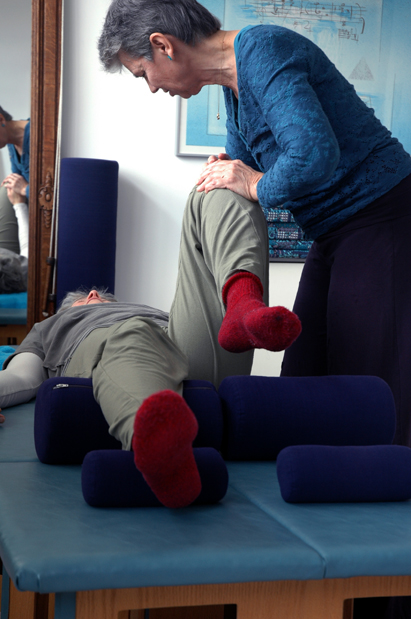
How an individual lesson unfolds
We always start with your question. You share what you’d like to change and how you experience your complaints or limitations. I ask some clarifying questions so I can clearly feel where to place our attention.
Then the real work begins: observing, listening, touching.
I ask you to stand so I can see how you organize yourself.
How do you distribute your weight?
How does your pelvis respond when you move in different directions?
Which foot bears more weight?
Which movements feel easy, and where does resistance arise?
I also have you walk, observing how the different parts of your body cooperate.
Often I ask you to make small comparisons:
Do your shoulders on the left and right feel like they move in the same way?
Next, we work either sitting or lying on my Feldenkrais table, depending on what your body responds to most. If sitting is a source of tension, we start there. If lying down offers more information, we choose that.
When lying down, we can often discover more quickly where comfort is possible and how to build further from there.
Working with complaints… or really with people
Most people come with complaints. I always ask instead:
Where do you want to go? What do you want to be able to do? How will you know you’ve achieved that?
If you’re only focused on “wanting to get rid of pain,” you’re steering yourself toward a problem.
When you explore what you would like to be able to do, space opens up toward a solution.
I don’t work with complaints; I work with people.
With everything you bring: stiffness, clumsiness, movement limitations, a busy mind… all of it is part of how you function, and all of it can change.
During the session, I move you from different positions, within the space your system allows. You discover new movement possibilities and let go of old, limiting patterns. The brain responds by creating new connections and allowing more space.
For at home, you receive movements that further deepen this newly found space.
An investment you carry with you for the rest of your life
I very often hear from people who once followed a series of FI lessons that they still benefit from them: “I still use what I learned from you back then every day.”
That’s why I call taking Feldenkrais lessons an investment in yourself.
That’s the power of this way of learning: what you’ve truly felt and embodied stays with you.
Would you like to book a session?
You’re welcome to discover how Functional Integration can help you find more ease, space, and freedom within yourself.