In our habits, we often tense far more muscles than necessary without even noticing.
This makes movements less easy, stiffer, and more angular. Often, this is also the underlying cause of muscle and/or joint pain. If we want to change that, we can start by looking at how movements are organized.
Cooperation between muscles
Every movement uses several cooperating muscle groups.
- The muscles that create the movement are called agonists. These muscles shorten to produce the movement and determine, among other things, the direction of what you’re doing.
- There are usually other muscle groups involved as well. These are called synergists, the muscles that support the movement.
- In addition, every movement has a number of muscle groups that work in the opposite direction. These are the antagonists. They have to release, let go, lengthen, stop contracting. The speed at which this happens influences how fast and how smoothly the movement unfolds.
This cooperation is what we call coordination between different muscle groups. It’s a process we usually don’t notice.
An example
Let me illustrate this interplay with a simple movement:
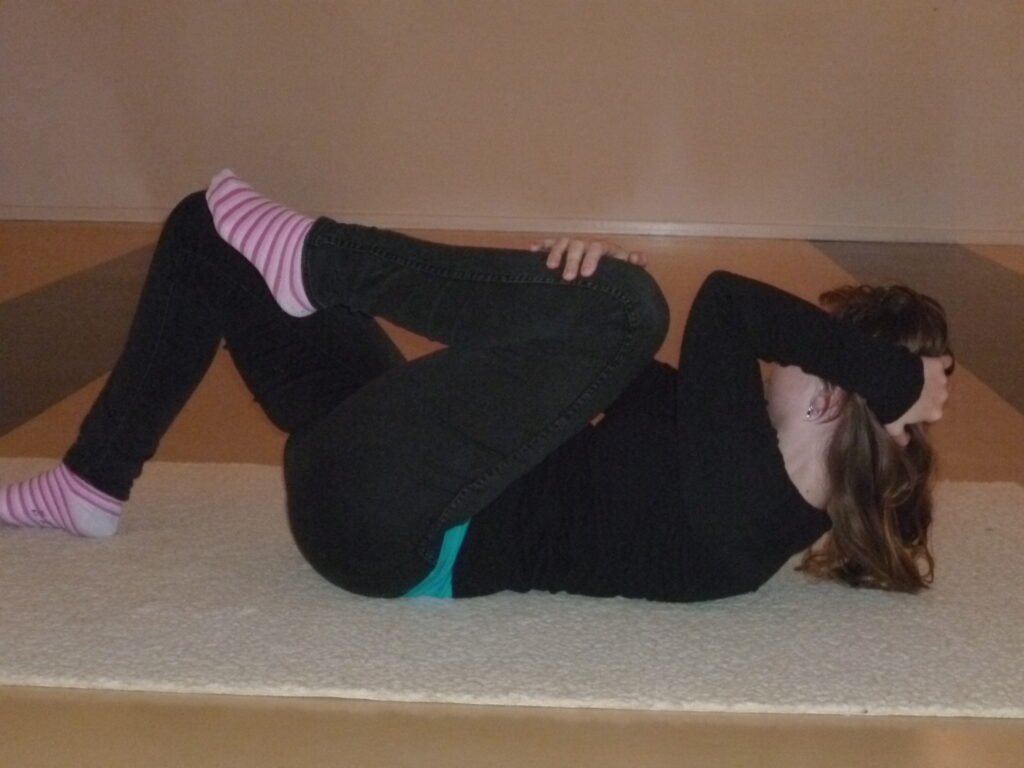 You lie on your back with your knees bent. Place your left hand behind your head so it can help lift your head. Place your right hand around your left knee, so you can bring it closer to your belly/chest. Then move your left elbow and left knee toward each other, allowing your head to lift with the movement, and then return to the starting position. Repeat this several times while noticing what happens.
Because gravity acts as a counterforce in these movements, the opposing muscles can pause their regulating work. Gravity provides enough resistance and regulation. This allows you to feel more precisely where you are actively working—in this case, the flexors at the front of the body. And you can feel where you are yielding and where you don’t need to tense at all—in this case, the extensors at the back of the body, including your long back muscles.
Habits
Out of habit, we often tense both the working and opposing muscles at the same time without noticing. That means that instead of releasing and lengthening, the opposing muscles—here the back and neck muscles—tighten as well. They continue their shortening action and unintentionally resist the movement. This makes the movement heavier and requires more strength and energy than necessary.
It also makes the movement of the skeleton less clear to you when both muscle groups are active at once. And that is exactly what you do want to sense: when the flexors are active, you want your spine to actually move in the direction of flexion and your back to round. You can feel this because certain parts of your body press more firmly into the floor, while others—like hip and shoulder—lift slightly off the ground.
Variations
 You can slowly change the direction of the movement, for example by bringing your right elbow and right knee together, or your right elbow and left knee (as in the photo), and vice versa. Or place both hands behind your head and bring both elbows and knees toward each other. Each variation makes you re-explore the cooperation between the front and back of your body, with slightly different relationships between agonists, antagonists, and synergists. By emphasizing lightness in the movement and sensing how your contact with the floor changes, the muscle groups begin to cooperate more efficiently. The movement gradually becomes lighter and easier. The cooperation between flexors and extensors improves, and better coordination emerges.