The Feldenkrais Method under the microscope
Why this way of moving brings about so much change
Many people who take Feldenkrais lessons quickly notice that their movements become lighter, pain diminishes, and daily life starts to feel easier. I see this happening again and again in my classes. But what actually lies behind this method? Which ideas formed the foundation of this work?
In this blog, I’ll take you into the world of thought of Moshe Feldenkrais, and show how his research developed into a method that makes a real difference for so many people.
A method born out of necessity
Moshe Feldenkrais developed his method because he himself could not continue without change.
An old knee injury eventually made it almost impossible for him to walk. His question was simple yet powerful:
“How is it that my knee functioned well for years, and now it doesn’t anymore? What has changed? And can I reverse that process?”
He discovered that almost all movement education assumes that sitting, standing, and walking are simply there by default. But that’s not true: we learned these skills ourselves. And if you once learned them, you can also rediscover how to do them in a lighter, more efficient, and more natural way.
Learning through sensing and moving
Feldenkrais observed how children learn to move.
He saw that new movements arise slowly, through small variations, playfully, curiously, and without pressure. Not through performance, but through curiosity.
Tempo plays a crucial role here. When a child discovers something new, it moves slowly. As soon as the movement feels right, it naturally becomes faster.
This became a key principle of the method: movements become lighter when you take the time to feel what is happening.
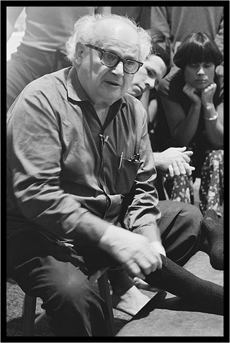
Movement, perception, thinking, and feeling as one whole
In Feldenkrais’ view, movement, perception, thinking, and feeling form one interconnected system.
In the Child’Space Training — where babies are observed daily — you can beautifully see these four elements developing together.
When you change one aspect, the other three move along with it.
So when you make a movement lighter and more precise, it’s not only your body that changes: your thinking, perception, and feelings change as well. That’s exactly what many people experience after a lesson.
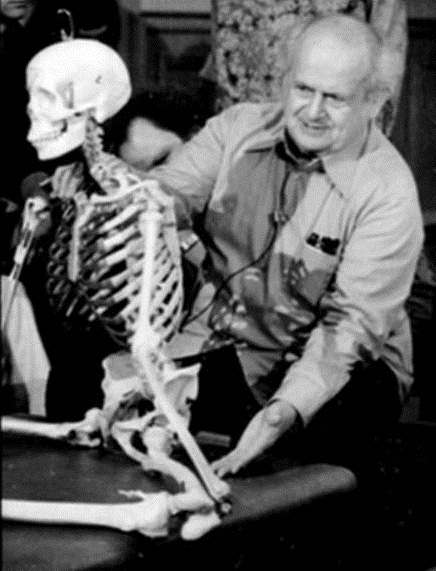
New connections, new possibilities
According to Feldenkrais, we use only a small part of our true potential.
When you explore new movement possibilities, new connections also form in your brain. This is what makes change lasting.
For many people, this opens up surprising capacities. I experienced myself how my confidence in speaking foreign languages changed during my Feldenkrais training — as if the brain reorganized itself and made room for something that had previously felt difficult.
Newness, the unknown, and playfulness are therefore core concepts in the Feldenkrais Method.
Sometimes a lesson feels like a puzzle; precisely because of that, something opens up that would otherwise remain closed.
An old Tibetan parable
Feldenkrais ended his book Awareness Through Movement with a parable that beautifully summarizes his vision.
Imagine yourself as a carriage:
the passengers are your wishes and dreams,
the horses are your muscles,
the carriage is your skeleton,
and the driver is your awareness.
When the driver is asleep, the horses pull in all directions and the carriage never truly arrives anywhere. But when the driver is awake — with attention and direction — cooperation arises. Everything moves in the same direction.
That is exactly what Feldenkrais aimed for: that your awareness, perception, movement, and feeling work together, so you can shape your life with more freedom and fullness.