What do you actually do in a Feldenkrais lesson?
Why experiencing matters more than explaining
When I ask my clients whether they’d like to invite others to an introductory lesson, I often hear:
“I don’t really know how to explain what Feldenkrais actually is.”
And honestly, I understand that completely. Feldenkrais is something you feel — not something you can easily put into words. That’s exactly why I offer free introductory lessons: your body learns through experience.
So I’d like to take you along into what happens during a lesson, and especially why it works the way it does.
How habits reduce your freedom of movement
Many people experience their body mainly through what no longer moves smoothly: a shoulder that keeps hurting, a back that keeps protesting, a neck that stiffens easily. Out of caution, we start avoiding movements — sometimes consciously, often without noticing. Over time, your movement repertoire becomes smaller without you realizing it.
I recognize this very clearly myself. When I had chronic back pain, I did everything I could to avoid lifting. I had all kinds of clever tricks: placing my shopping bag in exactly the right way so I only had to “hang” it, not actually lift it. Years later, after the pain had already disappeared through Feldenkrais, I suddenly noticed that I could lift a crate effortlessly.
That moment felt liberating: letting go of an old program that had once been necessary, but no longer made sense.
We all have these unconscious programs. They become so normal that we stop noticing them; they become part of how we think we “are.”
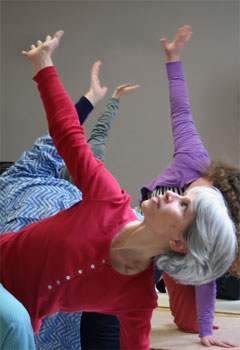
Habits you don’t see… but definitely feel
Many habits are more subtle than you might think.
Maybe you believe your shoulders are relaxed, while a few deeper muscles remain tense all the time.
Or maybe you unconsciously push into the floor while sitting, forcing your abdominal and back muscles to constantly compensate.
These patterns aren’t wrong — but they are limiting. They allow only one option: your habit.
And as long as that’s the only option you know, it seems like the only way to move.
How you gain more choice in movement
You can only change something if you can feel the difference.
That’s why Feldenkrais lessons work with variations: small differences, unexpected directions, new entry points. As soon as more than one option appears, you can feel which movement is lighter, safer, kinder to your body.
This is how learning works at the level of your nervous system: the more subtly you can sense what changes, the more precisely your body chooses what works best.
Not your thinking mind, but your brain makes the choice. It’s perfectly equipped for that — as long as you bring attention.
That’s why Feldenkrais lessons are like a learning garden: a place where your nervous system can play, explore, and learn to distinguish. Some movements are surprisingly simple; others may feel almost impossible at first. But they always invite you to become more spacious within yourself.
Why so many lessons are done lying down
Many Feldenkrais lessons begin on the floor.
That’s where the body is most supported, most relaxed, and least occupied with “staying upright.”
Returning to standing afterward often feels like a small revelation: you suddenly notice how you stand, how you walk, how much more length and ease there is, how differently you experience yourself.
That’s the moment when you feel what has truly changed — without having worked hard.
Want to experience it yourself? You can.
Are you curious?
You’re very welcome to come and experience what Feldenkrais can mean for you.
- Sign up for a free introductory lesson
- Download the free lessons on my website
- Try it with a 3-lesson pass
- Or purchase a series of 6 lessons, giving you plenty of space to explore at your own pace
Your body will let you feel what words can never fully explain.