A movement to feel this interplay
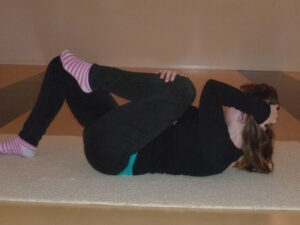 Lie on your back with your knees bent. Let your left hand rest behind your head so you can support your head when you lift it. Place your right hand around your left knee so you can bring it closer to your belly. Then slowly move your left elbow and left knee toward each other, letting your head naturally follow, and then return to the starting position. Repeat this a few times while sensing what happens within you.
Because you’re moving against gravity, the muscles that normally act as brakes can stay more in the background. Gravity takes over part of the regulating work. This makes it easier to feel where you are truly active — in this case, the front muscles that shorten — and where you can soften. The long back muscles, which often tense unconsciously, don’t need to actively participate here, making it clearer that they can give space instead of resistance.
Variations to refine cooperation
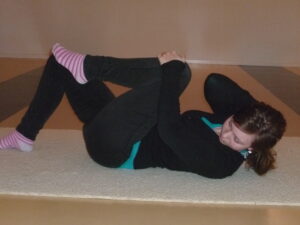 You can vary this movement in many ways by switching which hand is behind your head and which hand holds which knee. For example, you can bring your right elbow toward your right knee, or toward your left. Each variation creates a slightly different organization of flexors in relation to extensors.
Placing both hands behind your head and bringing both elbows toward your knees asks for yet another form of coordination between front and back. In all these variations, you keep searching for lightness — for small changes in your contact with the floor, for the moment when the movement becomes more effortless. You keep listening for the lightest part of the movement, noticing when your back muscles and other extensors don’t resist, and you return before it becomes heavy. Gradually, more harmony develops in the cooperation between your muscle groups, and the movement becomes lighter and more enjoyable.