Treating yourself sustainably, can you learn that?
How your body teaches you where your limits are
These days, sustainability is often about the Earth: how do we make sure we don’t keep exhausting it? But we can ask the same question of ourselves: how can we treat our body, our energy, and our capacity in a sustainable way?
And how do we prevent ourselves from quietly wearing ourselves out?
Many people react with surprise when I use the word “abuse” in relation to the body. Yet we do it more often than we realize. Habits we’ve had for years can place a hidden strain on us.
And it all starts with noticing.
If you regularly experience complaints — from sitting, working, exercising, or simply daily life — that’s often a signal that something isn’t quite right. Not because your body is weak, but because it has been trying for a long time to tell you that something can be different.
An example from practice
Jan is someone with lots of enthusiasm and an enormous drive to exercise. But time and again he ran into pain and injuries.
After various treatments, he decided to explore whether he himself could change something. That’s how he ended up with me.
What I immediately felt was that his muscles were constantly working hard. Not only during effort, but even at rest. As if he lived his entire life in “gale force 9.”
When your body is already producing that much force at rest, there’s hardly any room left for extra effort. Then every sporting activity is, by definition, too much.
I recognize that all too well from the time when I myself constantly had complaints. I always thought it was due to circumstances, headwinds, fatigue, a bad day.
But it was my own baseline tension that was working against me.
So is it about “learning to relax”?
Yes and no.
In Feldenkrais, you’re not focused on relaxation in itself. Relaxation can be a result, but the goal is much deeper:
rediscovering the natural cooperation between all your muscle groups.
Movement becomes effortless when:
- your bones are allowed to do the supporting
- your muscles do only what’s necessary
- you feel your movement instead of thinking it
- you’re not constantly working against yourself
When that happens, movement becomes light, simple, and surprisingly elegant.
The role of attention and feeling your skeleton
In Feldenkrais lessons, you direct your attention inward:
how do your bones move in relation to each other?
Where do you give way? Where do you hold on?
When you focus on that, your brain can activate exactly the muscles that are needed — no more, no less. You don’t have to “manage” it with your thinking. In fact, when you try to move from an idea, you often overrule the natural organization of your body.
That’s how you end up in gale force 9: always a bit harder, firmer, more active than necessary.
Is it really that simple?
The principle is simple, but it takes practice.
You have to learn to feel when movement is light… and when you’re pushing against resistance.
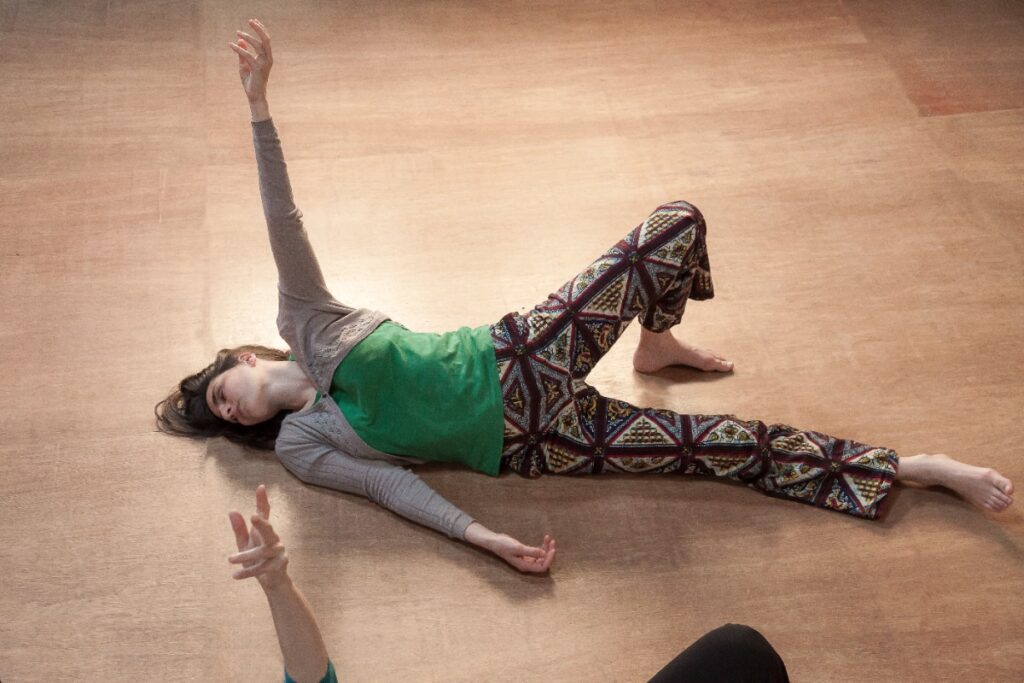
That’s why we do a lot of the lessons lying down.
Lying down makes it easier to distinguish, because your body is supported by the floor. You can then feel more precisely where movement flows and where it gets blocked.
And then there are beliefs that steer us from the inside. For example, the idea that “sitting up straight” means: shoulders back, back tight, abs engaged.
That costs a huge amount of energy and is almost never necessary.
When you learn to trust your skeleton, your support system, space opens up. Your muscles can do their real job: moving, not carrying.
I often see people change enormously in a short time because of this.
And Jan? He’s back to exercising with pleasure.
Do you recognize any of this?
Do you regularly feel discomfort, tension, or overload?
Or do you notice that your body struggles more than you’d like?
Feel free to respond. You’re probably not the only one.